
Jardin Majorelle Reveals the Architecture of Tomorrow
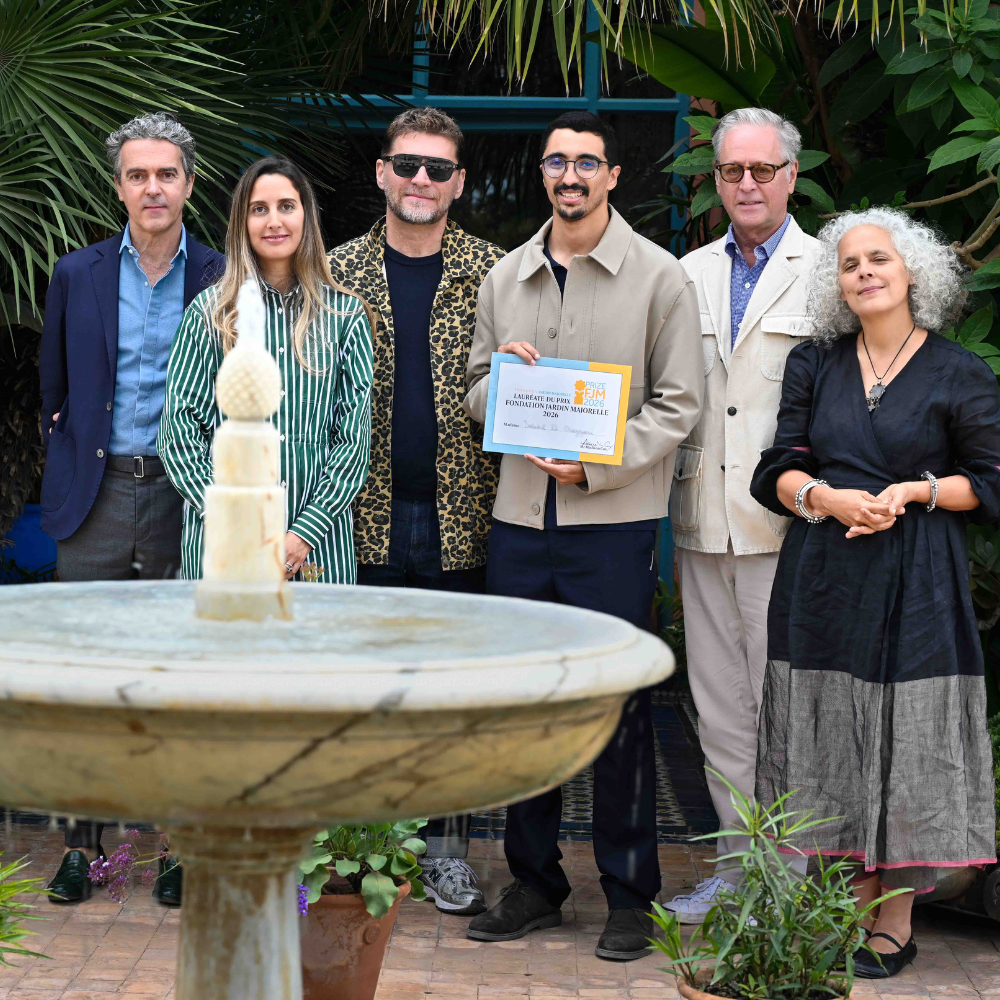
The Fondation Jardin Majorelle Prize honours a new generation of Moroccan architectural visionaries.
Beneath the shade of bamboo groves and amid the cobalt-blue walls that have made it one of the world’s most beloved gardens, the Fondation Jardin Majorelle announced the laureates of its prestigious architectural competition — a prize that is fast becoming one of the most coveted accolades in the Moroccan creative scene.
On 15 May 2026, Marrakech held its breath as the Fondation Jardin Majorelle unveiled the winner of the second edition of the Fondation Jardin Majorelle Prize (FJMP), a competition dedicated to the finest emerging architectural talent in the Kingdom. The announcement, made in the intimate and iconic setting of one of North Africa’s most storied gardens, drew the eyes of the architectural world to Morocco.
The winning project — Nouala, the moving shelter — was conceived by architect Salsabil El Ouazzani, who distinguished herself with a proposal that moved the jury with its rare combination of material intelligence, spatial sensitivity, and practical feasibility. In a single, poetic gesture, El Ouazzani managed to capture the soul of the Jardin Majorelle without betraying it.
Grand Prize — FJMP 2026
Selected for its choice of materials, its seamless integration within the garden, its elegance of concept, and the clarity of its realisation pathway — a shelter that breathes with the landscape.
The jury not only honoured the winning project but awarded a special mention — a testament to the extraordinary level of the proposals received, and to the vitality of Moroccan architectural thinking today.
A Competition That Captured a Generation
This second edition of the FJMP generated a remarkable response from Morocco’s architectural schools. Thirty-four applications arrived from students and young practitioners trained at institutions across the country — from the storied École Nationale d’Architecture de Rabat to those of Casablanca and Marrakech, from the Euro-Med School of Architecture, Design and Urbanism in Fès to the School of Architecture, Planning and Design at UM6P in Ben Guérir. The breadth of this participation speaks to a generation of young Moroccan architects who are confident, curious, and deeply engaged with their cultural landscape.
The quality of the submissions made the jury’s task particularly arduous. Each proposal was evaluated on its architectural relevance, its creative ambition, the sensitivity of its relationship to the Jardin Majorelle, and the sustainability of its conceptual approach. The projects that distinguished themselves understood something essential: to intervene in this garden is to enter into dialogue with nearly a century of living history.
The Jury: Architects, Anthropologists, Custodians
The jury assembled for this edition was a gathering of exceptional minds, presided over by Madison Cox, President of the Fondation Jardin Majorelle. Alongside him sat a constellation of figures embodying the intersection of creativity, heritage, and contemporary thought:
- Madison Cox — President, Fondation Jardin Majorelle (Chair)
- Hiba Ben Salek — Architect
- Karl Fournier — Architect, Studio KO
- Salima Naji — Architect & Anthropologist
- Alexis Sornin — Director, Musée Pierre Bergé des arts berbères & Musée Yves Saint Laurent Marrakech
This diversity of voices — architectural, ethnographic, curatorial — gave the FJMP jury a richness of perspective that is itself a statement of intent. The prize is not merely about building; it is about belonging, about memory, about the places where culture quietly persists.
Nouala: A Shelter That Moves With the World
The word nouala carries centuries of meaning in Morocco — a traditional rural structure, light and adaptable, built from local materials to shelter those who work the land. In El Ouazzani’s hands, the concept becomes something both ancient and radical: a temporary pavilion that does not impose, but listens. A structure that acknowledges the garden without competing with it.
“To inscribe a contemporary vision within an emblematic, history-laden place while respecting its singular identity and its soul — this was the challenge the jury set, and El Ouazzani met it with rare grace.” — Fondation Jardin Majorelle Jury

The Temporary Pavilion is situated within the Villa Oasis enclosure and is reimagined every two years by the FJMP laureate. It currently hosts the exhibition Les Oiseaux du Jardin Majorelle. All visitors to the Jardin Majorelle are invited to discover this living space of creation — a reminder that the garden itself is not a relic, but a place in continuous, generous becoming.
A Prize With a Mission
More than a competition, the FJMP represents a commitment on the part of the Fondation to the vitality of contemporary Moroccan creative practice. It offers emerging architects something rare: a platform with true visibility, embedded within one of the most visited cultural sites on the African continent. To win here is to be seen — by patrons, by curators, by a global public that passes through the blue gates of Majorelle each year in their millions.
By its openness and avant-garde spirit, the competition confirms an ambition to encourage a new generation of architects capable of imagining forms that are sensitive, sustainable, and profoundly rooted in their environment. In Salsabil El Ouazzani’s Nouala, and in El Mehdi Belyassmine’s Phyllocode, we see the shape of what Moroccan architecture might become: thoughtful, material, alive to place.
About the Fondation Jardin Majorelle Created to perpetuate the legacy of Yves Saint Laurent and Pierre Bergé, the Fondation Jardin Majorelle is dedicated to the preservation of the cultural, botanical, and architectural heritage of this emblematic site, while actively funding social, educational, and environmental projects across Morocco.
About the Jardin Majorelle Conceived in 1924 by French orientalist painter Jacques Majorelle, this botanical garden is a living masterpiece of exoticism, celebrated worldwide for its iconic ultramarine blue. Saved from destruction in 1980 by Yves Saint Laurent and Pierre Bergé, it spans nearly two hectares in the heart of Marrakech — a haven of peace, inspiration, and timeless contemplation for millions of visitors each year.

 © 2025 NIGHTY MAGAZINE . All Rights Reserved.